Showing posts with label politics. Show all posts

Friday, March 6, 2015

UKIP, Queerness, and Non-Reproductivity

This week, Vice published an amazing piece about the UKIP spring conference. The whole article is worth a read – every time you think it must have exhausted the cornucopia of preposterousness, along comes another sentence like 
A leaflet that was handed out as he spoke helpfully pointed out that foreign aid is actually spent on "giving dance lessons to Africans" 
 or 
"At the risk of sounding melodramatic, let's suppose our leader was issued with a European arrest warrant for allegedly stealing a chicken from a Carrefour in France"
Before I read the article, though, I saw this image circulating in isolation.

Image: a page from a flyer. A highlighted text box states that "What the LGBT is achieving, of course, is a recruitment drive. As such people cannot reproduce their own kind, they must recruit fresh 'blood' and this is best done among children in schools, the younger the better. The Government, through Gove and Morgan, has given them carte blanche."
It's easy to laugh at the naked scaremongering – the appeal to the tired old "predatory gays" trope, the implie conflation of queerness and pedophilia, the othering language of "such people" and "the LGBT" (which, ???) – but I think it's worth devoting some attention to the focus on reproduction.

That queers cannot reproduce is, of course, an anti-queer argument of long pedigree (see what I did there?). The Catholic church has thrown most of its anti-LGBT eggs into this philosophical basket, despite the elaborate theological hoop-jumping required to maintain this position while still justifying sex between infertile hetero couples. Its demonstrable falsity notwithstanding, the non-reproductivity argument still holds powerful rhetorical sway.

Look again at the flyer's language: 
As such people cannot reproduce their own kind, they must recruit fresh 'blood' and this is best done among children
See that must, both bolded and italicized. If queerness and pedophilia are conflated, as in the popular queerphobic trope that is certainly being invoked to some extent, the fresh blood to be recruited is a rainbow army of child prey, new meat for the insatiable sexual appetites of those voraciously vampiric queers who drain the bodily fluids from each victim before tossing them aside like so much offal. On this reading, queers need fresh blood because we are going through our finite supply of single-use sex partners at a rate of knots.

Simultaneously with this subtext, though, runs a second set of implied reasons for the queer recruitment drive, and that is simply "to reproduce their own kind." If this reproduction is intended to be analogous with human reproduction in its idealized form, in which parents are assumed not to prey sexually on their own children, then presumably queers are not recruiting these young schoolchildren to be our own sex partners. Recruitment, in the minds of the anti-queer flyering brigade, is the queer version of reproduction.

Queerness is definitionally non-reproductive to the creators of this flyer. Why, then, do queers wish to reproduce their own kind? They must do it, and the reason that they must do it is that they cannot do it. Self-evidently, non-reproductivity is a defect, and reproduction is the goal. For those who subscribe to the non-reproductivity argument against queerness, there is no "why" to reproduction. It's simply what living beings do.

I can't help wondering what would happen to this discourse if it came face-to-face with Lee Edelman. Edelman (No Future, 3, 4) exhorts queers to refuse the very terms of the argument that we must reproduce our own kind:
queerness names the side of those not 'fighting for the children,' the side outside the consensus by which all politics confirms the absolute value of reproductive futurism.  [...]
Rather than rejecting, with liberal discourse, this ascription of negativity to the queer, we might, as I argue, do better to consider accepting and even embracing it.
If we're talking pure biological fact, queerness is not definitionally non-reproductive, and straightness is not definitionally productive; but that's not the argument I want to have. Frankly, I don't want to have any argument that accepts the parameters UKIP sets.

Monday, August 13, 2012

For F---'s Sake, Watch 'The Thick Of It'

Cross-posted at Bitch Flicks, where I will be blogging every Monday for the foreseeable future. Awesomeness.

 
The fourteen episodes of Armando Iannucci's brilliant BBC show The Thick Of It appeared on Hulu a couple of weeks ago, and the upcoming fourth season will stream there as well. I am having a bafflingly hard time convincing even my most devoted Anglophile friends to watch it. Maybe the pace and intensity are off-putting: it's a show that demands your full, rapt attention to decipher its rapid-fire dialogue (and British accents, if that's a difficulty for you). Maybe the unrelenting cynicism is discouraging for my starry-eyed friends (I know a LOT of Aaron Sorkin devotees). Maybe the Westminster setting is daunting to Americans who assume that familiarity with the ins and outs of UK politics is a prerequisite, when in reality all a non-Brit would miss are throwaway jokes about odds and ends of British culture (Mark Kermode's flappy hands, anyone?). Whatever it is that's giving people pause, I wish they'd overcome it, because this is a really, really good TV show.

As a cynical comedy about the relationship between a hapless government minister and a Machiavellian civil servant, The Thick Of It is naturally a spiritual successor to excellent 1980s sitcom Yes Minister – but it is a very 21st-century successor. The archly satirical wit of Yes Minister isn't wholly absent from from The Thick Of It, but it is rather overshadowed by, well, the gloriously colorful and endlessly creative obscenity. A viewer conducting even the most casual compare-and-contrast of the two series will notice two interesting trends:

1. Twenty-first-century Westminster is no less white than 1980s Westminster. This, unfortunately, is a reflection of reality: people of color currently comprise 4% of MPs (a figure that was significantly lower when The Thick Of It began in 2005), and Parliament's own website admits that even though “[t]he House of Commons is more reflective of the population it represents than ever before […] it remains the case that more than 400 MPs, 62% of the total, are white men aged over 40.”

2. There is a far wider variety of accents, and a hell of a lot more swearing, in the newer show. This is something that cannot be explained without a brief discussion of the deeply complex question of class in British politics, so please bear with me. UK politics has always been an old boys' club. The traditional track to Westminster runs through a private school, ideally Eton, and a top-tier university, ideally Oxbridge. That same Parliament webpage notes that over a quarter of current MPs went to Oxbridge, and over a third went to private schools. This is vastly disproportionate to the general population – but it is an improvement over the past. In 1982 Yes Minister could include lengthy rants about Greek and Latin quotations and jokes mocking a minister who attended the LSE; one suspects that that simply wouldn't fly today.

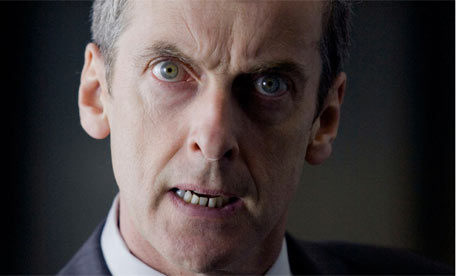
The delicate subtleties of regional accents in the UK are far beyond my capacity to explain; suffice it to say that, first, regional accents are historically the marker of a working-class background, and, second, they are much more acceptable in politics and media today than they were 30 years ago. There is, then, a more or less explicit class dynamic at play in The Thick Of It between the RP-accented ministers and the very Scottish Peter Capaldi, who stars as very terrifying government spin doctor Malcolm Tucker.

Good God this man is terrifying.
 
Malcolm is the core of the show, and he is a wonder to behold. In creating Malcolm Tucker, Iannucci seems to have drawn from both his own Scottish heritage and from the well of “terrifying Scot” archetypes that populate the British imagination: from Wallace bellowing “FREEDOM!” to Miss Jean Brodie to Professor McGonagall to the monstrous Manda in Alan Warner's The Stars In The Bright Sky (get a copy; you'll thank me later), echoed in US pop culture through figures like Groundskeeper Willie and Shrek. An explosive hurricane of Caledonian fury, Malcolm tears through Westminster, bullying, threatening, effing, blinding, and occasionally punching anyone unfortunate enough to oppose his will. He's the kind of villain who's an absolute joy to hate, reveling in his own evil machinations and spouting quotable profanity like it's going out of style.

Not that the other characters lack for memorable quotes. The writing for this show reminds me of Oscar Wilde (in a potty-mouthed, 21st-century kind of way): all the characters essentially speak with exactly the same voice, but it's such a very funny voice that nobody really minds. And, of course, a great strength of this style is that the women characters sound as though they were written to be characters first, women second. Our culture is swimming in female characters who sounds as if they were written by someone who, at best, has never actually interacted with a woman, and, at worst, genuinely believes women to be a completely different species than human beings. Armando Iannucci's women are not like this at all, and it's depressing how refreshing that is.

In my opinion, The Thick Of It only really hits its stride with the introduction of Rebecca Front as Nicola Murray, MP, in the third season. (The first two were only three episodes each, so that's still more than half the show that she's in.) This was a matter of necessity, owing to Chris Langham's ignominious fall from public grace, but it gives the show a dynamic it really needs. When Langham's Hugh Abbott was the hapless minister struggling to hang onto his job in the face of mockery from special advisers Glen and Ollie and relentless terrorism from Malcolm, the cast was just too homogeneous. Nicola has to deal with not only the pressures Hugh faced as an overworked, underprepared, perpetually outgunned minister trying desperately to be relevant; but she also has to cope with the specific challenges of being a woman in a job that is still 78% male-dominated. Dubbed a “glummy mummy” by the press, Nicola is caught in the damned-if-you-do, damned-if-you-don't position of the woman in the high-pressure job – expected to prioritize her work while simultaneously being the World's Greatest Mother, in a way that men are simply never expected to do. Being at the nexus of such impossible expectations never overwhelms Nicola's character or turns her into a straw person of any kind, but it is a constant presence in the dynamic of her interactions with others, to the point that even the ferocious Malcolm appears to have a little sympathy for her.

Poor Nicola.
 
Iannucci seems to have recognized how interesting this dynamic is, and attempted to replicate it this year in his HBO show Veep, starring Julia Louis-Dreyfus as a (once again) hapless vice president. Veep is an intriguing attempt to transplant the magic of The Thick Of It to a US context (foreshadowed to some extent in the transatlantic hijinks of 2009 alternate-universe spin-off film In The Loop), but I'm not yet convinced that it's a fully successful one. For one thing, the US televisual landscape is so prudish that even on HBO the swears don't roll off tongues as organically as on British TV. For another, the lack of a truly nefarious Malcolm Tucker figure, while an understandable artistic choice to create distance from The Thick Of It, in my opinion undermines the show's cohesiveness. And I question the wisdom of choosing to piss away a potentially really interesting pregnancy subplot offscreen.

My reservations notwithstanding, I will be watching Veep's second season, because it's pretty funny, and because I trust Armando Iannucci. But I'm much more excited for The Thick Of It season four, and it would be nice if the rest of America cared too.

Sunday, June 3, 2012

"Non-Belonging Is My Very Substance"


"I feel that I exist only outside of any belonging. That non-belonging is my very substance."
--Edmond Jabès, From the Desert to the Book


I was born in Scotland, I went to high school there, and my parents still live there. In the US, I tell people I'm Scottish – it's just easier. However, it's not strictly accurate. Both my parents are English, so I lack the Braveheart ancestry (which is what most people in the US mean when they say “Scottish”); I spent my childhood continent-hopping, so I lack the emotional ties, personal history, and identifiable accent of one specific place (which is how a lot of people seem to relate to a place they call “home”); and, to be perfectly honest, if my parents moved away tomorrow I doubt I'd ever go back to Scotland.

I'm not really Scottish.

At first, I tried telling people I was “British” or “from the UK,” to which if not my accent then at least my passport can attest, but nobody who's really British ever says that. People claim England, Scotland, Northern Ireland, Wales: the place they identify as being from. The UK is a political fiction – not that any nation-state isn't; but the UK seems to be a particularly unconvincing one, at least as far as hearts and minds are concerned. I certainly don't “feel” British. I have no heart-and-mind national allegiance.

I'm not really anything.

These days, I try not to be a douche about this. It is both easy and insufferable to bang on about being “a citizen of the world, you guys” when you possess both the geopolitical privilege of a UK passport and the socioeconomic privilege to take advantage of the myriad doors that passport opens. I also try not to fall into a self-pity-party about my sense of alienation. My errant childhood may have robbed me of any place to call “home,” but it also gifted me broad horizons and an unslakable wanderlust – a tradeoff I'd not reverse for anything.

Sometimes, though, I do feel a secret wish to able to participate in outpourings of jingoistic fervor.

I've been witnessing such an outpouring from certain of my Facebook friends over queen whatsit and her diamond thingamajig. I am, as that last sentence might have tipped you off, firmly in the small-r-republican camp when it comes to the whole monarchy malarkey. Even if I somehow felt myself to be authentically British, my deep cynicism regarding autocratic headship, even of the mostly-symbolic variety, wouldn't permit me to do anything other than sneer at the whole business.

But, gosh, it looks like such fun.

I feel the same sense of alienation and frustration at international sporting events. Look at all these people, who are capable of (a) claiming a national identity without feeling like an impostor and (b) giving a rat's rear-end about the event in question! They all seem to be having SUCH FUN. I wish I could have fun.

Alas, I am a fun-killing overthinker with no ability to switch off my cynicism and no sense of belonging anywhere. But, on the upside, Salman Rushdie says I am a special snowflake.

Saturday, September 17, 2011

AlterNet's Ableist Language

Last week I sent AlterNet the following email:

I'm a big fan of Alternet and its sharp analysis of political issues. I really do appreciate the work you do here.

However, I'm troubled by the prevalence of ableist language on this website. Nearly ever article about the GOP seems to be headlined with the word "crazy", "lunatic", or equivalent. Conflating political extremism with mental illness is a trope that does a great disservice to people with mental illnesses, as well as failing to offer any meaningful critique of political extremists (who are often being irrational, greedy, mendacious, hate-mongering, and many other more accurate adjectives than "crazy"). Last year the (now sadly defunct) website FWD (feminists with disabilities) had a great post explaining this: http://disabledfeminists.com/2010/05/28/ableist-word-profile-crazy-to-describe-political-viewpoints-or-positions/

I hope you'll consider eliminating, or at least scaling back, your usage of ableist language in your headlines, because this is a great website but it really does bother me to see an otherwise progressive site perpetuate such a harmful and regressive trope.

Keep up the good work!

I was referring to headlines like Confessions of a GOP Operative Who Left “the Cult”: 3 Things Everyone Must Know About the Lunatic-Filled Republican Party and 6 Crazy, Unconstitutional Laws Right-Wingers Are Blowing Your Money On. Search AlterNet for terms like “crazy” and “lunatic” and you'll see they've been doing this for years. It upsets me, and I finally decided it was past time to bloody well call them out on it.

The only reply I got was a generic thanks-for-your-feedback auto-response, so I don't know if my email was read or taken on board... but the AlterNet front page does not currently bear a single headline using the words “crazy”, “lunatic”, or “insane”.

I intend to keep an eye on this, of course. I imagine others have called out AlterNet on the same issue, and I'll be extremely chuffed if they've changed their policy. If you do see another headline there using ableist language, I urge you to email them about it (feel free to copy-paste all or part of my email).

Sunday, September 11, 2011

And What Did It Mean For You?

I was twelve years old when it happened. Living in Kenya at the time, so it was evening for us, I was at choir practice after school. The mothers used to wait for us in their cars, lined up outside, listening to the radio: they heard it unfold in real time.

Maybe the news report was too confused to make sense of, maybe she just couldn't process it and wanted to talk it over with Dad, maybe she wanted to preserve our innocent, excitable chatterings about the forthcoming choir trip to Europe a while longer; whatever her reasons, our mother didn't tell us until later that night. “Something's happened...”

Of course it was all anyone could talk about at school for the next two days. Did you see the footage on the news? Will there be a war? Could we be collateral damage? (Checking atlases to map air routes from the US to the Middle East, figuring that other African nations to our north were likelier to take a hit...)

By the end of the week, the playground scuttlebutt had moved on to more immediate topics (never borrow a ruler from R; J once saw her using it to scratch her crotch!), but in my life there had been a quiet cataclysm. Before that day, I had never watched, read, or otherwise paid attention to the news; on the Wednesday, I instantly became the news and politics junkie I've been for the past decade.

Talking with some friends this week, I found that most of us had a similarly dramatic awakening to the news, usually at around the same age. Whether it was TWA Flight 800 or Columbine, some horrifying event had left a peculiarly indelible mark on our young consciousness, permanently altering our understanding of the world and our place in it.

Recently I found an old diary entry featuring my initial reaction to 9/11, a short paragraph in a shaky hand. It's an odd mixture of endearing childishness and white-hot fury: a naivete outraged and forever scarred by the realization that humans would actually do something like this to other humans, that atrocities are not the preserve of history class – not something we've as a species outgrown – but are something we still commit on one another.

(The 1998 bombing of the US Embassy in Nairobi might have been the catalyst for my realizing this, had I been a little more precocious, but at nine I was still more concerned with Polly Pocket than with international terrorism.)

I don't think 9/11 was a direct cause of my seven years as an agnostic – the major impetus, aside from just reaching an age when my critical thinking skills had developed enough to start questioning the beliefs I grew up with, was my close friendship with a girl who had survived the car crash that killed her mother and little sister – but it must have been a contributing factor. When you suddenly live in a world where things like that can happen, all security is gone. A car could kill your family any day. A terrorist could kill you at any time. Can you trust in anything?

I'm indulging in this onanistic little response to the anniversary of a major world tragedy because I don't want to resort to the empty cliches that dog almost every attempt to analyze 9/11 on a national or international scale. No doubt I'm falling prey to cliches of a different sort: the navel-gazing explication of ~What 9/11 Means To Me~ that risks trivializing the tragedy by reducing it to a psychological input for some tedious privileged not-personally-affected westerner. But I'm a member of the 9/11 generation. 9/11, and its aftermath, shaped us and shaped the world we're inheriting. It's our touchstone, our point of contact with one another, our collective awakening to the ugliness humans are capable of: to a sense of our own mortality.

Wednesday, August 17, 2011

The Pursuit of Bootstrappyness

So I watched this movie, The Pursuit of Happyness, and it was pretty gross. I don't mean Trainspotting gross, or Saw LXIV gross. In fact it's directed strictly at middlebrow sensibilities, competently directed and well-acted, hitting all the predictable beats of your standard Oscar-nomination-getting story.

And it's precisely because a story like this is seen as so innocuous, such gloopy inoffensive awards-bait, that we need to talk about why it's so gross.

Will Smith plays a father and salesman who is struggling to make ends meet. He takes on a highly competitive unpaid internship at a stockbroker's, but when his baby mama walks out on him and their five-year-old son he's left destitute. His only hope is to be the bestest intern the stockbrokers have ever seen, so that they will choose him over the other 19 interns to get the paid position at the end of the six-month internship. Calamity piles on calamity, and before long Will Smith and his son are homeless and sleeping in public restrooms and homeless shelters – well, the son is sleeping; Will Smith studies by night, and, because he is a superhuman with no need for such mundanities as sleep, manages to be the bestest ever intern and win the job. Happyness: pursued, caught, skinned, barbecued, and eaten.

How is this narrative gross? Let me count the ways:

1. Harpyness

Thandie Newton plays Will Smith's girlfriend and the mother of their adorable moppet Jaden (well, he's Smith's moppet IRL). Newton gets to do exactly two things in this movie:

  1. shriek at Will Smith over his inability to pay the rent; and

  2. leave town, never to be heard from again.

Now, Newton's behavior toward Smith is actually pretty understandable. She's been working double shifts at her job, but they still can't make their payments because Smith is unable to sell the transmogrifiers he's invested in. Yelling at him isn't right or helpful, but I sympathize because I imagine she's under huge amounts of stress (especially since, as is implied later, she never particularly wanted to be a parent). However, I sympathize only because I have years of feminist deprogramming making me hypersensitive to any portrayal of a female character; the problem is, we never actually see her work problems or her stress (or her doing anything other than yelling at him, really) – and because the entire film is focalized through Smith's character, we see the ill fortune that dogs his honest attempts to sell his transmogrifiers, we see Newton not giving him a chance to explain before starting to shriek, and so your average filmgoer probably just thinks, “Damn, what a harpy.”

Personally, I'm fascinated by her story. It sounds as though she didn't want to be a mother, and only carried her pregnancy to term because of baby daddy's insistence. The story of a reluctant mother assailed by the mounting pressures of family and financial concerns until one day she can't take it anymore would be an original one for Hollywood, at least if it were told sympathetically; but, no, the concept that a mother might find something in life more important than motherhood is just too radical for our Extreme Leftist Hollywood.

2. Crappyness

These characters are working class. I know you don't use that term in America, but they are. They live from paycheck to paycheck; perhaps at the beginning of the film they are hovering on or just above the poverty line, but as it goes on they slump into undeniable poverty. A combination of accumulated parking tickets, unsympathetic landlords, and the ultimate evil that is TAXES leave our protagonist utterly destitute. He and his boy have to go live in a homeless shelter; with no income at all, Smith has to pretend to all the high-flying stockbrokers that everything is just swell and dandy.

(Now I'm thinking about it, how does he pay his son's daycare fees during their homeless period? Surely the $25 from donating blood would go toward food and bus fares.)

The rich white people treat poor black Will Smith like dirt. They make him fetch their coffees and donuts, they make him park their cars, they generally treat him like their darkie servant. And yet the film feels no need to make any comment on this racism. In fact, once Will Smith accepts an invitation to attend a football game with a very rich stockbroker and his creepily Aryan son, he manages to keep crawling on up until the rich white people accept him as one of them. Congratulations, poor black man! Because you did what the rich white people told you and swallowed their humiliations, you've been permitted to ascend to their level! If you lick their boots some more, maybe they'll let you join the whites-only country club! There's no critique of this system. The rich white people's position is presented as the ideal – as the happiness Will Smith's character is pursuing – and the fact that he's had to crawl on his belly and let them treat him with total indignity is a mere inconvenience. Suck it up, boy.

3. Bootstrappyness

Just as there's no critique of the racist aspects of Smith's ascent, there's no critique of the class system. A story like this is the ideal avenue to explore class inequity in America: rich people swan around to their boxes and golf courses, oblivious of the fact that right in front of their eyes are millions of people who can't afford basic amenities, who can't lend you $5. I'd like to see the story of Smith's character building relationships with the other poverty-stricken people around him, building solidarity with others who have been screwed over by a vastly unequal society. But he never engages with those around him in any way (except to fight another homeless guy for a place at the shelter). He's better than they are. Unlike them, he doesn't deserve to be here. He'll haul himself out of there by his bootstraps. He'll claw his way to the top of the system that screwed him.

The myth of the “American Dream” is that anyone can do anything. Will Smith's character even speechifies at his son to this effect: “Don't ever let somebody tell you you can't do something. Not even me. ...If you want something, go get it. Period.” But the vast, vast majority of people living paycheck-to-paycheck can't do anything they want. There are just too many obstacles, a whole system twisted against them. By only telling rags-to-riches stories – never acknowledging the inescapable poverty that is reality for millions – Hollywood is reinforcing the idea that the underdog can always win, that if you're still poor it's because you didn't try hard enough, you didn't want it hard enough, you didn't have enough grit and daring: that it's your own fault.

At the end of the movie, Will Smith and his son walk down the street in their nice new rich-person neighborhood. The houses are huge, the street is clean, and the shuffling hordes of the homeless, among whom they not so long ago were queuing desperately for a night's shelter, are nowhere to be seen. Out of sight, out of mind. You hauled yourself up by your bootstraps – they can darn well do the same.

Thursday, August 11, 2011

Love The Haters

You know what's really, really hard? Loving your enemies.

It's such a pat phrase that I don't often really think about what it means. Circumstances don't currently compel me to spend time with people I don't like, so I find myself dismissing this commandment: “eh, don't really have any enemies.”

If there's one thing I've learned from this whole ugly riots mess, it's that I absolutely do. And I've been able to codify something about myself that makes me feel a little weird:

I have a lot more sympathy for people whose actions repel me than for people whose words repel me.

I condemn the rioters' actions while seeking to understand their point of view. Good job me. Top marks on loving your enemy right there. But the people who are saying horrible things about the rioters, impugning their humanity and calling for mass murder (encasing them in concrete and unleashing polar bears on them are just two of the suggestions I've seen on Facebook)? I condemn them without even trying to understand their point of view.

Maybe it's because my hate-spewing Facebook-friends are mostly a lot like myself in terms of background and socioeconomic circumstances – heck, a few years ago (pre-SJ, pre-Christianity) I might well have been saying the same things myself – and the reason I'm lashing out at them is because I understand them too well, and I want to distance myself from the things I could all too easily see in myself.

So what does it mean to love your enemies?

Let's start with enemies. That is like a ridic melodramatic word in today's parlance. Obviously it means the people you find it hardest to love. For me personally, I think ideological opponents is probably a better term. The fantastic Christian Humanist blog recently linked this super-interesting article, which argues that

“...as a culture, liberalism has become insular and narrow-minded. It lacks the capacity for the generous appreciation of other points of view needed in a pluralistic society. That capacity is more likely to be found today among conservatives, particularly religious conservatives.”

That's a helluva thing. Now, I don't really consider myself a liberal – liberalism's a little far right for my tastes – but it's certainly closer to me than conservatism, and (without wanting to get into discussion of whether it's a valid or defensible statement) this bold, extremely questionable assertion has got me examining my beliefs more critically than ever before.

I have an unfortunate tendency to pride myself on my “generous appreciation of other points of view”. I'm constantly checking my privilege, trying to be super-duper politically correct, accounting for the multifarious effects of background and circumstance and identity politics. The only people whose point of view I don't try to understand?

Right-wingers. People who don't seem to care about social and economic justice. People whose politics are in direct opposition to mine.

The thing is, in my actual interpersonal relationships I am okay at this. I have friends who are conservatives. I dearly love certain people who are racist, sexist, heterosexist, etc. When I was a small child living far away from my biological grandparents, an older couple living in our neighborhood were surrogate grandparents to me and my brothers, and I vividly remember the shock of learning, years later, that they believed God made black people and white people separate and we should stay that way. It was the first time in my life I confronted head-on the truth that sometimes people you care about have really objectionable views, and it's a lesson I've had to keep on learning.

And yet it's easy to make exceptions and justifications for people you already know and love. When the people with objectionable views are mere words on a screen, it seems logical and right to put principles above people.

To really live a Christian life, though, means always putting the people above the principle. (Side note: one of the reasons I adore children's fantasy classic Silver on the Tree is because of its take on this issue.) It is possible to reject someone's objectionable views but still understand and love em. It has to be possible. That's what God does: God understands all of us completely, and God loves all of us completely, and God absolutely rejects injustice and hatred.

How does God do it? I don't friggin' know. That's why God's God, and I'm not. I do know that it's my duty as a human being to try as hard as I possibly can, and that as long as I live it's going to be really, really hard.

Wednesday, August 10, 2011

Final (I Hope) Words On The Rioters

You can attribute the riots to naked human greed, selfishness, and lust for violence. And you wouldn't be wrong.

You can also state that the cause of World War One was naked human greed, selfishness, and lust for violence. You can say that they were the cause of the Holocaust. Of British colonialism. Of genocide in Rwanda. Of every terrible thing humans have ever done.

And you would be right.

But – and this is history 101 – obviously they're not the only cause. Because, if they were, riots and World War One and genocide wouldn't be events to be commented upon, analyzed, and condemned. They would be happening nonstop. Brutality is latent in all of us, but humans as a group don't go round acting on this brutality without some kind of cause. Even if the cause is only opportunity without fear of the consequences (in which case, we should be asking why there is opportunity and why there is no fear of the consequences).

By blaming only the greed and selfishness of individuals, who are you helping? What are you achieving? You're not helping people who have lost everything to the awful arson and looting. You're not helping the people who feel powerless, disenfranchised, and angry. You're not helping the people who feel so disconnected from society that they think it's okay to smash shops and steal stuff and set buildings on fire. You're not helping the society that has failed to make these people feel a part of it.

And you're sure as shit not stopping this from happening again.

Tuesday, August 9, 2011

London Riots, Media Narratives, "Scum"

I used to trust the media to tell me the truth, tell us the truth

But now I see the payoffs everywhere I look

Who do you trust when everyone's a crook?

Revolution calling...

--Queensrÿche, “Revolution Calling”


First of all, that is an awesome song off a seriously awesome record. Second of all, it is some cold hard TRUTH.

One of the things I love about social media is its ability to tell us what's really going on. The more I engage with the blogosphere, the more I understand how mainstream news sources are all skewed to a certain framework. It's not a great conspiracy; it's not even necessarily a bad thing – it's just that every part of the media has an agenda. Value-neutral example: earlier this year, when all the US news sources I follow were glued to the protests in Wisconsin, the only US-related item in the BBC evening news was coverage of Spider-Man: Turn Off The Dark. That's because the BBC's agenda is to be the British Broadcasting Corporation, so it skews Britain-centric. What's important is to be aware of the skews and biases in the media you consume – and, ideally, to vary your news media diet enough that you can piece together a picture of the world by seeing it from different angles.

What's astonishing to me is how many people I know are uncritically consuming the mainstream media narrative of the London riots.

David Cameron has called them “criminality, pure and simple” and promised a tough response. An awful lot of people are being very vocal about their agreement with his rhetoric and his tactics.

For days now my Facebook feed has been flooded with snarling, reactionary calls for the protestors' blood. When I posted a request for people not to use the nasty, dehumanizing, highly prevalent term “scum”, I got a wealth of “but they ARE scum!” responses.

Now, I joined Facebook when I started university, so my Facebook friends are primarily people who are attending or have recently attended one of the world's highest-ranked universities – which is a nice way of saying that my friends are predominantly white and middle-class. And, as much as it sickens but doesn't really surprise me to see the awful violence spreading across England, I'm sickened but unsurprised to the same degree to see my Facebook friends spew hatred and violent rhetoric about the rioters.

I don't condone the violence. Obviously. But the braying self-righteousness of these responses is indicative of people who don't want to try to understand. They're not prepared to engage with the complexities at hand. They're not willing to examine the socioeconomic and political contributing factors. It seems to me that they just want to point the finger at looters and arsonists, declare their moral outrage, and sit back feeling smug that they would never act like those scum.

Well, how the fuck do you know that?

Youth unemployment is over 20%. Not everyone can get into a top university and rely on the mater and pater to support them financially (speaking, I hasten to add, as one who did and is doing exactly that). Not everyone can broadly trust the police to not kill them. Not everyone is white and middle-class. Who the hell are you to judge people “scum” when you haven't even tried to understand where they're coming from?

To you, it's just teenage hooligans embracing their greed and lust for violence. To you, it's just mindless criminality. Why not consider the decades of disenfranchisement and poverty, the long-term unemployment and feelings of hopelessness? Do those not factor in at all?

Read this article. Read the comments on this Shakesville piece. Try thinking critically about the narrative spoonfed you by the media-political complex. And chew on this for a second:

Though I'm a peace-loving, Jesus-loving, violence-condemning hippie radical of the far left, it's not the riots that are making me despair for humankind. It's you.

Monday, August 8, 2011

Oh, London

I may have grown up in Alabama and Kenya and Scotland; I may be about to move thousands of miles away; I may have spent only about 15% of my life there - but, if there's anywhere in the world I consider home, it's London.

London! The very name sets my heart beating faster. City of culture unparalleled. City of sprawling humanity. City of my life's significant moments. City full of my friends and relatives.

Oh, London. Looking on from the outside, I don't understand what is going on; but my heart is very much inside you, burning as you burn, breaking as you break. Plague and fire, 7/7 and Blitz: every threat you've outlived has left you shattered, yet stronger.

I'm afraid and I'm appalled. I can only pray that people will come to their senses. I can only pray that the ones I love will be safe. I can only pray that my beloved city will cope.

London, my London... Be strong. Have faith. Bear up. You are Neverwhere, you are Un Lun Dun, you are Mother London. You are London. There's nothing you can't face down.

Monday, July 11, 2011

That's The Thing About Living In A Capitalist Kyriarchy

You have to participate.

Unless you're one of the lucky few with the ability and the spoons to opt out entirely (and probably even if you are; I've not visited any self-sufficient, totally egalitarian collectivist communes lately), you're not only psychologically tainted by the bullshit kyriarchal norms into which the culture has been indoctrinating you from the moment you left the womb/test-tube/mothership [delete as appropriate]; you also have to actively participate in oppressive systems. By which I mean, you need food and shelter and healthcare and entertainment; for which you need money; for which you need a job.

More and more, I'm convinced that capitalism as we know it is fundamentally not an okay system, and it's not just 'cause I'm lazy. (I am, but I have ideological objections too.) I'm still in the (probably lifelong) process of forming my exact political beliefs, so I'm not yet sure whether my objection is to capitalism as currently implemented – the “it's a good theory, but doesn't work in practice” line so often applied by left-leaning moderates to communism – or (hello, Karl) to the very theory and idea of capitalism itself. At this end, I suppose it doesn't matter terribly: either way, I'm compelled to participate in and contribute to a system I think is profoundly wrong.

What I want to do is establish a coherent ideology for myself, and seek ways to enact that ideology in the world. (Isn't that what we all want?) In order to do that, I'm going to grad school, which means I'm participating in and shoring up a classist and discriminatory system. (By “discriminatory”, of course, I don't mean the practice of discriminating between those with the aptitude for graduate study and those without; I mean the complex network of socioeconomic circumstances that contrive to deny aptitude its fulfilment.) In order to go to grad school, I need to save money, which is why I currently have a job.

Don't get me wrong: I quite like my job. I know, it weirds me out too, especially since my first experience working in the world of customer service was so completely disgusting – but that's a story for another day. My current job is pretty decent; but sometimes my ideals are clashing headlong with the requirements of my job.

I want to call out my 70-year-old coworker, of whom everyone – managers included – is a little afraid, when she's being racist. But I don't. I want to beg everyone that asks for a ticket to The Hangover Part II to reconsider this disastrous life choice and instead see a movie that isn't quite such a hatefully offensive piece of garbage. But I don't. I want to give servicemen and -women the same discount we give students, because having a student discount but no military discount strikes me as classist. But I don't. I need to keep this job, and I need a good reference when I leave, so I keep my mouth shut, I don't rock the boat, and I betray my beliefs so that I can continue to participate in a system that is also against my beliefs.

Is it craven? Undoubtedly. Is it pragmatic? Absolutely. It's compromise; it's jumping through hoops; it's a deal with the devil.

It's living in a capitalist kyriarchy. It's how it works.

Sunday, June 12, 2011

Coming Out

I don't talk about when I came out. That phrase makes it sound as though it were a simple, closed, one-off action, which couldn't be further from the truth. No, I talk about when I started coming out. You start coming out the day you admit to yourself (or to your diary, if you're an embarrassingly pretentious dork like me) that you're not the hetero you and everyone else always assumed you are; I'd venture to guess that you finish coming out the moment you shuffle off this mortal coil, though I suppose it's possible that the afterlife is also a stew of awkward assumptions and pronoun acrobatics.

It's a truism, but coming out really is a life-long process. And it's bloody difficult, especially for those of us with an inadequate grasp of conversational nuance. Every time you meet someone, you over-analyse and second-guess everything. Is ey assuming you're straight, or staying open-minded? If you drop a reference to a girlfriend past or present, does that constitute “rubbing your sexuality in eir face” (a phrase that always makes me giggle)? As a generally out gay person, how far into a new acquaintanceship should you explicitly let the other party know you're gay? Could this apparently reasonable and friendly human being transform into an ugly and violent homophobe at the first mention of Melissa Etheridge?

As a queer radical, I sometimes feel that I ought to be proclaiming my gayness at the top of my lungs every waking moment: I should get my hair buzzcut, my face pierced a few more times, and my neck tattooed “GRRL LOVER”, and I should greet everyone with, “Hi, I'm Anna and I am a big ole queer.” That, I suppose, would be the purest manifestation of my political ideology.

But I am not a pure manifestation of political ideology; I am a human being with multiple identities, a sense of discretion, and not inexhaustible reserves of mental strength. Queer is something I am, but it is not the totality of who I am, nor even the most important aspect. It's perhaps the most marginalized of my identities, which is why I feel the need to weaponize it; but I just don't have the wherewithal to be in such a constant state of frontline warfare with the dominant culture. Of course, I am in a constant state of warfare with the dominant culture, but most of that is mental: and, given how exhausting that is, I simply haven't the energy to bring it in a loud, visible fashion every day of the week.

Moreover, I'm afraid of retaliation. I admit it: when my political ideology clashes with my self-preservation instinct, not getting punched in the face dominates nine times out of ten.

(Plus, my hair is great. I love it and will not sacrifice it at the altar of extreme butchness.)

The people it's easiest to come out to as gay are often the hardest to come out to as Christian. (And vice versa, no doy.) In my experience, the communities least likely to make assumptions about your sexuality are the most likely to make assumptions about your secularity. It's deeply frustrating: if I can have a great conversation about Jesus with you, I'll be afraid to talk about Rachel Maddow with you; if we're having fun discussing queer theory or your palaeontology degree, I'm going to have a hard time bringing God into it.

And yet I know that there are many, perhaps even a majority of, individuals who are open to the idea of a queer theologian-to-be. My fear of coming out as gay, Christian, or a gay Christian is exactly what the kyriarchy wants. The compartmentalization and conflict of your different identities is one of the ways you're kept fighting yourself and your potential allies, instead of the actual oppressive forces.

We're all afraid to be judged, outcast, or even physically harmed for who we are. Sometimes this fear is reasonable, often it's not, but in the minefield of social interaction it can be hard to tell. However, I do know this: if you don't know about my very personal passion for social justice, or about my mad dorkiness, or about my love for the Big Guy upstairs, then you don't know me.

Wednesday, June 8, 2011

An Open Letter To The World's Men

Dear Men:

I believe in you. I believe the same things about you that I believe about people of all other genders: that you have access to your fundamental goodness, that you have the divine spark living inside of you, that you are capable of conquering your baser instincts and demonstrating great love and achieving great things.

A few of you seem to be doing your best to make me stop believing.

Some men, when they are in a position of power and influence, use their power to rape or sexually abuse others. Some men in a position of power and influence use their power to cheat on their spouses, almost invariably while propounding a “family values” platform or capitalizing on the alleged strength of their (monogamous, heterosexual) relationships. Some men in a position of power and influence tweet inappropriate pictures of themselves.

But I will not let the few affect my beliefs about the many. I will not succumb to the temptation to draw harmful generalizations about all men. Or about all heterosexual cis men. Or even about all white heterosexual able-bodied cis men in positions of power and influence.

I believe in individuals. I believe that the brain is mightier than the penis. I believe that the conscience can be stronger than earthly power, if we only let it.

I believe in you, and I won't let a few – or even a lot of – horndog politicians destroy that belief.

But, you know, feel free to vindicate my belief in you sometime.

Tuesday, June 7, 2011

I Have A New Favorite Poem

SURVIVOR
by Roger McGough

Everyday,
I think about dying.
About disease, starvation,
violence, terrorism, war,
the end of the world.

It helps
keep my mind off things.

* * *

I came across this in a book called The Nation's Favourite Comic Poems. Thoughts?

Friday, May 27, 2011

Everyday Queering

Have you noticed how everyone says QUILTBAG now? It's a quality acronym, obviously – if you're too lazy to click that link, it stands for:


Queer/Questioning

Undecided

Intersex

Lesbian

Trans*

Bisexual

Asexual

Gay/Genderqueer


Good, eh? More inclusive (and waaaaay more pronounceable) than LGBT.

Personally, though, I like to use “queer” as my umbrella term for all that stuff. I know some people have problems with the q-word – mainly older LGB folks to whom it still carries the resonance of a slur – but even academia has reclaimed it.

The reason I like “queer”, though, is that it's a verb as well as an adjective and noun: it's not just something you are, it's something you can do. Cis, het, monogamous people with 2.4 kids in the suburbs aren't a part of the QUILTBAG community, but they're still capable of queering.

What do I mean by queering? Anything that challenges normative behaviors or attitudes around sex and gender. Anything that critiques the dominant, heteronormative culture. Anything that might introduce somebody to the concept of deconstructing their identities.

Even the tiniest actions matter. These parents are queering radically (and I think they are awesome), but not everybody needs to do what they're doing. Even the humblest challenges to the kyriarchy can open that crucial door in somebody's mind.

Buying pink booties for your cousin's newborn son: that's queering.

Teaching your young kids that trans*, intersex, and genderqueer people exist: that's queering.

Not correcting the shopkeeper who took you for the opposite sex: that's queering.

Reminding the right-wing Christian who's always talking “family values” that Jesus not only was unmarried (celibate; perhaps asexual?), but also rejected his biological family in favor of his friends (OMG JUST LIKE ON BUFFY THE VAMPIRE SLAYER)? Queering.

Using Spivak pronouns in everyday speech? Queering.

Sometimes I feel sorry for cis heteros, because they have to try that much harder if they want to challenge the kyriarchy. We QUILTBAG types queer the place up just by existing, but y'all have to do something. And that's also why I appreciate you queering non-queers so much.

Friday, May 6, 2011

A Question

Do you ever wish you could just switch it off? Just stop caring? Do you ever wish you could dial the empathy right down to zero for a day?


Do you ever wish you could sit down at the computer and not feel the obsessive urge to watch The Rachel Maddow Show and check AlterNet every ten minutes? Do you ever wish you could swear off the social justice websites for a while, and only read about pop culture and funny kittens?


Do you ever wish you could read about Western foreign policy without a welling sense of shame and dread? Do you ever wish you could contemplate worldwide human rights abuses without feeling sick to your stomach? Do you ever wish you could accept war and poverty as unfortunate but unchangeable facts of life?


Do you ever wish you could walk past a homeless person without being swamped by guilt and sorrow? Do you ever wish you could pass the sick kids' hospital without feeling your eyes fill with tears? Do you ever wish you could witness the gap between rich and poor without raging against the injustice?


Do you ever wish you could watch a TV show without internally criticizing its depiction of people of color? Do you ever wish you could see a movie without wishing for better representation of women? Do you ever wish you could engage in feminism and LGB activism without getting incensed by the frequent erasure of trans* people?


Do you ever wish you could stop caring?

Wednesday, May 4, 2011

“I Love Elections. I'm Having One Right Now”: Some Thoughts On Voting

The other night, I had a big argument with my parents. It was a family argument in the Jewish sense: a minor disagreement leading to a heated philosophical debate that gets the juices flowing, unveils deeply-held beliefs for a thorough savaging, and leaves everyone feeling warm, fuzzy, and closer than ever before. (As a general FYI, if you're the kind of person that finds big arguments upsetting rather than unifying, you probably shouldn't date anyone who can claim descent from the Chosen People. Just sayin'. From rabbinical midrash to which pages of the Pesach haggadah we can skip to whether Superman or Batman or Spider-man is the best, bonding through disagreement is in our heritage and in our blood.) (Have I mentioned before that I'm Jewish as well as Christian? Future posts will explore this further, I promise.)

The subject of our argument was feminism. I think my parents view my feminism the same way they view my being gay: they don't totally get it, but they've come to accept it as a part of who I am, and they're willing to engage with it. A lot of people believe in the fundamental tenets of third-wave feminist thought, even if they wouldn't self-identify as feminist, and my parents are no exception. But when they asked me what I think about affirmative action, or “positive discrimination” as they put it, we parted ways.

I said that I think affirmative action is far from ideal, but it's at least an attempt at redressing the centuries of imbalance and ongoing institutional bias against minorities. They said it's unfair to punish today's white men for the privilege enjoyed by their forebears.

It would be quite possible to spend a few hundred thousand words unpacking everything that's going on in this dispute, but if you're reading this blog you're presumably – unlike my parents – familiar with a lot of it, not least my feelings about white people, my feelings about privilege-denying, and OH MY GOD WE CAN'T FORGET ABOUT TEH WHITE MENZ WHO IS GOING TO TELL THEIR STORIEZ? So, yeah, there's still plenty of educating to be done (Mother, Dad, I love you, start here), but at least we agree on one thing: the system is broken.

Our world is a zero-sum game. Earth's resources are finite, so where one person gains something, somebody else loses out. Human society is broken on such a fundamental level that I don't know how to begin fixing it, and that's one of the reasons I believe in God – because I don't see how we can possibly get ourselves out of this mess without outside help. (This is also why I hope for benevolent extraterrestrials to gift us with their wisdom before we run out of resources.) As such, I'm not sure there's any such thing as unqualified Right in this life. Every attempt at a good action has bad consequences, either immediately or somewhere down the line. Does this mean we should stop trying? Surely not; that way lies despair.

Today, the UK is holding local elections and a national referendum. Voter turnout at local elections tends to be dismally low, and I'm sure that one of the reasons for this is a widespread belief that the system is broken beyond saving and that therefore there is no right choice.

That's true. There is no right choice. I've been a voter for four years now, and most of those votes I wish I could retroactively change. (Not just my conscience-defying Lib Dem vote last year - would you believe, in my very first local election I voted Conservative? In defense of my younger, stupider self, they're the most unionist party, and that was back when we feared the SNP might walk the walk of Scottish independence instead of just talking the talk.) However, there's not one of those votes I would retract altogether. I'm proud to have voted in every UK election – local, European, London mayoral, general – since I turned eighteen.

I vote because of Emily and Emmeline and Millicent. I vote because of Martin Luther King Jr. and Rosa Parks. I vote because of every person in world history who has ever fought or died for a right that I was gifted on a platter at birth just because of where I was born and who my parents are.

I have serious issues with the whole concept of nationality. (And I have issues with my issues, because I'm very conscious that said issues are largely a product of the oceans of socio-economic privilege that permit a comfortably transnational childhood like mine.) However I may feel about it, I own a UK passport and I benefit from that hugely, in a number of ways. When the UK government takes action, it does so in the name of the British electorate – in my name. Given a chance to influence, even in the tiniest of ways, what is done in my name, how can I not take it?

Whoever I vote for, it won't change the fundamental injustices of our world. But I have to do what little I can: when life hands you a teaspoon, you darn well use it.

Saturday, February 19, 2011

Terrible People Saying Terrible Things

[As always, cross-posted at Newsgrape.]

A couple of weeks ago, a friend sent me this link. I know it’s long, but I’ll wait while you read it.

.

.

.

Welcome back! That article is the reason I made a resolution to quit supporting the Daily Mail. Not that I’ve ever bought it, given it my money, recommended it to a friend; but, like many a sneering leftie (the Mail website gets three times as many hits as any other paper’s), I used to occasionally follow links to their more ridiculous articles, so I could chortle in disgust and self-righteousness at the wilfully ignorant hatemongering about “gay maths”. The Mail, though, doesn’t know I’m mocking it; it still registers as a hit, and that increases the site’s popularity and helps generate ad revenue for a truly repulsive institution. In short, my self-righteousness was unjustified, and now that I’ve resolved never to visit the Daily Fail website again, I can be properly self-righteous about it.

However, all the leftist brownie points this resolution gets me are cancelled out by my ongoing sick fascination with the awful Simon Heffer.

My parents have a personal vendetta against Rupert Murdoch, but they find the Guardian’s Saturday crossword too difficult; so, every Saturday, they take the Telegraph. They are the first to admit that it’s a dreadful bloody paper, and they frequently talk about subscribing to just the crossword online so they don’t have to be seen buying it, but bad habits die hard, and anyway they like having a TV Guide.

There are a few pages of the Telegraph that I always look at: the back cover, which has the crossword and the weather; the birth announcements, which sometimes include some real gems (“Zavier Thomas Knox, a brother for Zakari and Zahra”, “to Spencer Harvard-Walls and Tabitha Aldrich-Smith, a beautiful daughter, Tatiana Skye”, “Christobel Sophia Eleanor, a sister for Charlotte Grace Alexandra” – and those are just from the past couple of weeks); and Simon Heffer’s column.

Simon Heffer is a truly odious man. For a while I thought he might be a satirist, a sort of British Stephen Colbert; then I wondered if he could be a time traveller from 200 years ago, brought forward by a controversy-hungry newspaper to rail against modern society from his deeply unpleasant, reactionary standpoint; but, honestly, he’s just an ass.

Heffer is the perfect example of somebody with his head so far up the patriarchy that he can’t see what a raving misogynist he is. He boasts of “gallantry” (vomit) and says things like “how can the Commons take speaker John Bercow seriously if he can’t control his wife?”. This is a columnist being published in a mainstream newspaper in 2011. In the same column, he made mention of his wife, and I am gravely concerned for Mrs Heffer’s wellbeing, given that she is married to a man who publicly states his belief – IN 2011! – that a husband should “control his wife”.

His misogyny is evident in slightly more subtle ways too. I recall, during the recent Labour leadership contest, a column throughout which he referred to David Miliband, in true former public schoolboy fashion, as “Miliband D”, but condescendingly called Harriet Harman “Hattie”. A man who insists on giving a woman politician a patronizing nickname is clearly a man who has deep and troubling issues in his attitude toward women generally.

Heffer also seems to be going for a world record in his invocations of Godwin’s law. I envision him throwing a dart at a customized dartboard in order to choose which group of self-evident non-Nazis he will accuse of Nazism this week. Recent targets have included people who believe in man-made climate change and, brain-achingly, people who speak out against racism, sexism, and homophobia. Given the baffling frequency with which they accuse assorted left-leaning groups of Nazism, I am beginning to wonder if certain right-wingers are privy to some little-known documentation – Hitler’s Very Secret Diary, perhaps? – in which the Nazis outlined their plans to end discrimination, promote equality and tolerance, and make all concentration camps carbon-neutral.

Or, you know, maybe they’re just idiots.