Showing posts with label class. Show all posts

Monday, October 22, 2012

Counterreading 'Here Comes Honey Boo Boo'

[Originally posted at Bitch Flicks, which you should definitely be reading regularly.]

 
Reality television has never held much appeal for me. I get plenty of reality in reality, thanks – I like my TV fictional. Besides, hasn't the last decade or more of respectable journalism assured me, in the shrillest possible tones, that reality TV is the very lowest form of entertainment, positively reveling in the filth of humanity's worst, most voyeuristic excesses: a Coliseum for the digital age?

SATIRE!!!111

Even without watching it myself, I've become less and less comfortable with the traditional critiques of reality TV as I've sharpened my critical apparatus. For a start, it seems predicated on the notion of a hierarchy of art, the assumption that some forms of entertainment are somehow innately higher or better than others. It's a terribly condescending form of knee-jerk moralizing. And if you don't ever watch it, it's a bit presumptuous to be judgmental about the whole genre.

I've tried to stay in the moral middle ground, having no real opinion on reality TV other than that it's not for me. I'd likely have continued my reality-TV-free existence, had it not been for this excellent piece at the incomparable Womanist Musings.

Renee and Sparky watched TLC's infamous Here Comes Honey Boo Boo, the reality show about six-year-old beauty pageant contestant Alana and her working-class Georgia family, and their reaction was not necessarily what you'd expect. They make many terrific points about how repugnant the show is as a piece of television, how it “other[s the family] at every turn,” but they also offer an invaluable counterreading. They like this family – the four daughters aged between six and seventeen, the quiet father figure, and heroic matriarch June – and they'll continue to like them, no matter what the show's structure seems to want us to think.
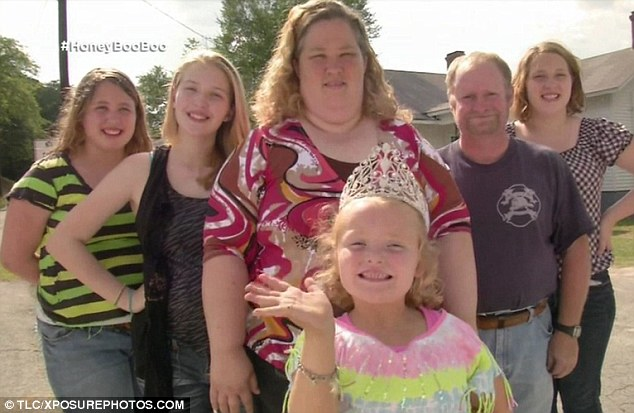
I love them all, but "Pumpkin" is my favorite.

If you consume entertainment and have any conscience at all, you are a practiced counterreader. You have to be, if you're going to stand up to the hateful kyriarchal bullshit with which 21st-century westerners are bombarded every minute of the day. All responsible entertainment consumption requires a risk assessment, weighing the potential value to be gained against the potential harm to be done, and everybody's evaluation is slightly different. For one person, well-rounded white female characters but no characters of color is worth the trade-off; for another, it simply isn't. And sometimes performing an adequate counterreading requires you to marshal all your critical resources.

Here Comes Honey Boo Boo is not a text that welcomes counterreadings with open arms. Operating well within the established format of reality television, it utilizes an arsenal of techniques – both subtle and not so much – to impel voyeurism. TLC makes it very, very easy to sneer at and judge Honey Boo Boo and her family. You have to work quite hard to counteract this compulsion. You really have to be on the critical ball the whole time. And is that okay?

All summer the debate has raged as to whether, or to what extent, the show is exploitative. Having watched all of it inside of a week, I'm still undecided. There are moments when June and the girls express a self-awareness and a confidence that has me cheering them to the skies, sure that their assertions of not caring what people think of them are sincere. At times, though – especially when outsiders are brought in to interact with the family, an etiquette teacher or a pedicurist, and get all flustered and shocked by them – the whole thing seems enormously exploitative and gross.

It's this indeterminacy, this openness to a multiplicity of different interpretations, that has the national conversation about Honey Boo Boo going so fiercely. As Time's James Poniewozik observes:
...overall, she has a kind of sassy sweetness to her. In the second episode, she gets a pet teacup pig as consolation for losing a pageant and decides to dress him as a girl, which she says will make him gay. The ensuing argument with her older sister is both ridiculous and oddly wise in a 6-year-old way: “It’s not gonna be gay.” “Yes it is, because we’re making it a girl pig! And it’s actually a boy pig!” “O.K., but it’s not gonna be gay.” “It can if it wants to. You can’t tell that pig what to do.”

You can’t tell that pig what to do. See, you can look at that scene, like you can most of Honey Boo Boo, several ways. You can laugh at the intensity of Alana’s conviction that she’s right. You can tut-tut at the gender-role signals this pageant girl must be getting to conclude that you can “make” someone or something gay by dressing it in girl clothes. But you can also see something kind of remarkable in it: a little country girl, whatever confusion and misinformation she has in her mind, fervently arguing a teacup pig’s right to determine its own sexual identity.
AWWWW

There are plenty of other interesting aspects of this show (Salon considers the race angle; Slate tackles the class issue), but the two that can't be ignored are the gender dynamic and the class factor. The gender dynamic is pretty glorious: five strong, opinionated women who love each other deeply and don't take anyone's shit. They do what they want to do, they look how they want to look, and they are happy. Dare I suggest that one of the reasons the country's spent its summer in thrall to these people is that we just don't see women like this in our scripted entertainment?

Of course, it's rare to see poor white people portrayed sympathetically on US TV at all. My understanding of class in the US is much less nuanced than my understanding of the British class system, but I'm aware of this country's distaste for its own working poor. “Rednecks” appear in the media as rapists, as racists, as the butt of jokes and the object of revulsion. Voyeurism and disgust motivate hate-watching in our culture to an obscene degree, and that is why I think it's important to perform a counterreading, to celebrate this family and refuse to let your responses be dictated by classism and hatred. If you want to be truly horrified by your fellow humans, check out the comments on this Gawker article (I hope you have a strong stomach). To me, this is the aspect of Honey Boo Boo that's truly awful – not a happy family letting a camera crew into their lives in exchange for some money they surely need, but the legion of haters who judge Honey Boo Boo and her family to be less human, less worthy of dignity and respect for their life choices, than themselves.
The family certainly does not reciprocate that sentiment. Even in the throes of labor agony, when asked, “Do you recommend to anybody else to get pregnant at 17?”, oldest daughter Anna replies, “Do whatever you want to do.” She just refuses to tell anyone else what to do with their body or their life. The rest of America – from legislators to judgmental internet commenters – could learn something from her.

Monday, August 13, 2012

For F---'s Sake, Watch 'The Thick Of It'

Cross-posted at Bitch Flicks, where I will be blogging every Monday for the foreseeable future. Awesomeness.

 
The fourteen episodes of Armando Iannucci's brilliant BBC show The Thick Of It appeared on Hulu a couple of weeks ago, and the upcoming fourth season will stream there as well. I am having a bafflingly hard time convincing even my most devoted Anglophile friends to watch it. Maybe the pace and intensity are off-putting: it's a show that demands your full, rapt attention to decipher its rapid-fire dialogue (and British accents, if that's a difficulty for you). Maybe the unrelenting cynicism is discouraging for my starry-eyed friends (I know a LOT of Aaron Sorkin devotees). Maybe the Westminster setting is daunting to Americans who assume that familiarity with the ins and outs of UK politics is a prerequisite, when in reality all a non-Brit would miss are throwaway jokes about odds and ends of British culture (Mark Kermode's flappy hands, anyone?). Whatever it is that's giving people pause, I wish they'd overcome it, because this is a really, really good TV show.

As a cynical comedy about the relationship between a hapless government minister and a Machiavellian civil servant, The Thick Of It is naturally a spiritual successor to excellent 1980s sitcom Yes Minister – but it is a very 21st-century successor. The archly satirical wit of Yes Minister isn't wholly absent from from The Thick Of It, but it is rather overshadowed by, well, the gloriously colorful and endlessly creative obscenity. A viewer conducting even the most casual compare-and-contrast of the two series will notice two interesting trends:

1. Twenty-first-century Westminster is no less white than 1980s Westminster. This, unfortunately, is a reflection of reality: people of color currently comprise 4% of MPs (a figure that was significantly lower when The Thick Of It began in 2005), and Parliament's own website admits that even though “[t]he House of Commons is more reflective of the population it represents than ever before […] it remains the case that more than 400 MPs, 62% of the total, are white men aged over 40.”

2. There is a far wider variety of accents, and a hell of a lot more swearing, in the newer show. This is something that cannot be explained without a brief discussion of the deeply complex question of class in British politics, so please bear with me. UK politics has always been an old boys' club. The traditional track to Westminster runs through a private school, ideally Eton, and a top-tier university, ideally Oxbridge. That same Parliament webpage notes that over a quarter of current MPs went to Oxbridge, and over a third went to private schools. This is vastly disproportionate to the general population – but it is an improvement over the past. In 1982 Yes Minister could include lengthy rants about Greek and Latin quotations and jokes mocking a minister who attended the LSE; one suspects that that simply wouldn't fly today.

The delicate subtleties of regional accents in the UK are far beyond my capacity to explain; suffice it to say that, first, regional accents are historically the marker of a working-class background, and, second, they are much more acceptable in politics and media today than they were 30 years ago. There is, then, a more or less explicit class dynamic at play in The Thick Of It between the RP-accented ministers and the very Scottish Peter Capaldi, who stars as very terrifying government spin doctor Malcolm Tucker.

Good God this man is terrifying.
 
Malcolm is the core of the show, and he is a wonder to behold. In creating Malcolm Tucker, Iannucci seems to have drawn from both his own Scottish heritage and from the well of “terrifying Scot” archetypes that populate the British imagination: from Wallace bellowing “FREEDOM!” to Miss Jean Brodie to Professor McGonagall to the monstrous Manda in Alan Warner's The Stars In The Bright Sky (get a copy; you'll thank me later), echoed in US pop culture through figures like Groundskeeper Willie and Shrek. An explosive hurricane of Caledonian fury, Malcolm tears through Westminster, bullying, threatening, effing, blinding, and occasionally punching anyone unfortunate enough to oppose his will. He's the kind of villain who's an absolute joy to hate, reveling in his own evil machinations and spouting quotable profanity like it's going out of style.

Not that the other characters lack for memorable quotes. The writing for this show reminds me of Oscar Wilde (in a potty-mouthed, 21st-century kind of way): all the characters essentially speak with exactly the same voice, but it's such a very funny voice that nobody really minds. And, of course, a great strength of this style is that the women characters sound as though they were written to be characters first, women second. Our culture is swimming in female characters who sounds as if they were written by someone who, at best, has never actually interacted with a woman, and, at worst, genuinely believes women to be a completely different species than human beings. Armando Iannucci's women are not like this at all, and it's depressing how refreshing that is.

In my opinion, The Thick Of It only really hits its stride with the introduction of Rebecca Front as Nicola Murray, MP, in the third season. (The first two were only three episodes each, so that's still more than half the show that she's in.) This was a matter of necessity, owing to Chris Langham's ignominious fall from public grace, but it gives the show a dynamic it really needs. When Langham's Hugh Abbott was the hapless minister struggling to hang onto his job in the face of mockery from special advisers Glen and Ollie and relentless terrorism from Malcolm, the cast was just too homogeneous. Nicola has to deal with not only the pressures Hugh faced as an overworked, underprepared, perpetually outgunned minister trying desperately to be relevant; but she also has to cope with the specific challenges of being a woman in a job that is still 78% male-dominated. Dubbed a “glummy mummy” by the press, Nicola is caught in the damned-if-you-do, damned-if-you-don't position of the woman in the high-pressure job – expected to prioritize her work while simultaneously being the World's Greatest Mother, in a way that men are simply never expected to do. Being at the nexus of such impossible expectations never overwhelms Nicola's character or turns her into a straw person of any kind, but it is a constant presence in the dynamic of her interactions with others, to the point that even the ferocious Malcolm appears to have a little sympathy for her.

Poor Nicola.
 
Iannucci seems to have recognized how interesting this dynamic is, and attempted to replicate it this year in his HBO show Veep, starring Julia Louis-Dreyfus as a (once again) hapless vice president. Veep is an intriguing attempt to transplant the magic of The Thick Of It to a US context (foreshadowed to some extent in the transatlantic hijinks of 2009 alternate-universe spin-off film In The Loop), but I'm not yet convinced that it's a fully successful one. For one thing, the US televisual landscape is so prudish that even on HBO the swears don't roll off tongues as organically as on British TV. For another, the lack of a truly nefarious Malcolm Tucker figure, while an understandable artistic choice to create distance from The Thick Of It, in my opinion undermines the show's cohesiveness. And I question the wisdom of choosing to piss away a potentially really interesting pregnancy subplot offscreen.

My reservations notwithstanding, I will be watching Veep's second season, because it's pretty funny, and because I trust Armando Iannucci. But I'm much more excited for The Thick Of It season four, and it would be nice if the rest of America cared too.

Wednesday, December 14, 2011

Bacon-Flavored Strawberries: Gene Marks Is Socially Constructed, And So Are You


So the latest face-melting jackassery doing the Tour de Shame on the SJ blogosphere is this prize putrescence, “If I Were A Poor Black Kid”. It's exactly as skull-crushingly awful as you'd expect: a rich white dude bragging about how he would be way better at poorblackkid-ing than poor black kids are, and if only people who actually are poor black kids would be as good at poorblackkid-ing as this rich white dude would totally be, then they could all be rich white dudes too. Or: “If I hadn't been born at the top of the heap, I'd've pulled myself up here by my own bootstraps!”

Obviously this is pukatronic, in more ways than I can possibly enumerate, but I think the thing that frustrates me most about Poorblackkidgate is the utter lack of self-awareness. Postmodernism is older than the Beatles; it should be old hat by now, and yet apparently people – people who are given a platform and are listened to – are still unwilling or unable to acknowledge that they are socially constructed. A rich white dude cannot say, “If I were a poor black kid...”, because it is meaningless. If he were a poor black kid, he would not be the person he is. He would have different opinions, different personality traits, different ways of expressing himself. In writing his article, he envisions Himself – Gene Marks, rich white dude – transplanted into the body of a poor black child, all his beliefs and morals and experiences and viewpoints intact. It's a breathtaking failure of imagination.

Ours is a very individualistic, libertarian, self-determinative society. We all like to think that our Self is this essential inner truth which simply is. Time and time again, though, it's been proved that most (if not all) of our identity is socially constructed.

Example:

Born this way” seems like a nice sentiment at first. Don't discriminate against me, because I didn't choose to be gay any more than I chose to have big feet. Well, that's problematic of itself (it smacks of apology: if I could choose, I'd totally be straight!), but “born this way”? Demonstrably not. Ancient Rome didn't have Pride parades, because Ancient Romans didn't have the cultural category of “gay”. They had gay sex, just like every human society, but they had no concept of “gay” as an identity. If I'd been born in Ancient Rome, I would not be gay, because the categorization of sexual orientation did not exist. My sexual desires might be the same as they are now, but they would not be framed as ontological gayness. I would not be gay.

What frightens people, and makes them reluctant to admit to their social construction, is that they think this would make their identity/selfhood somehow less valid. It doesn't. My being gay isn't any less real for being a social construct. President Obama's blackness isn't any made less significant by race being a scientifically nonsensical category. Social realities are still realities.

Saying, “If I were a poor black kid, I'd pull myself up by my bootstraps to reach the position I'm in today” ignores social realities. It's pure fantasy. It's like saying, “If this piece of bacon were a strawberry, it would be a bacon-flavored strawberry.” You're imputing the properties of bacon to something that is not bacon, and thus what you are saying is nonsense. If this piece of bacon were a strawberry, chances are very good it would taste like a fucking strawberry.

This is why I got so angry back in August at the rhetoric demonizing the rioters in London. To dismiss criminals as sub-human “scum” is to completely overlook the social construction that makes breaking the law unthinkable for you but quite doable for them. To say, “If I were a poor black kid I'd work really hard and get good grades” is to utterly ignore the social construction that makes bootstraps seem like the solution to you but unrealistic for, you know, actual poor black kids. It's the Enlightenment fallacy I wrote about last time: assuming that your (probably straight/white/rich/cis/male) reality is everyone's reality.

Recognizing that you are socially constructed does not make you not socially constructed, any more than recognizing your privilege makes you not privileged. What it does do is give you the critical tools to identify the way specific aspects of yourself are socially constructed, to understand therefore that other people are constructed differently, and to sympathize therefore with their point of view. It confers on you the epistemological humility to see that yours is not the only, nor even the definitive, reality. It empowers you to question everything you've always been told about how the world works, both explicitly and implicitly, and to see in what ways power differentials and systemic injustices are shored up by cultural reification.

It's arguably the most important tool you can have, and – unlike BOOTSTRAPS!!1eleventy – it doesn't require you to begin from a particular social location. If Gene Marks were self-aware, he wouldn't be talking about bacon-flavored strawberries.

Wednesday, August 17, 2011

The Pursuit of Bootstrappyness

So I watched this movie, The Pursuit of Happyness, and it was pretty gross. I don't mean Trainspotting gross, or Saw LXIV gross. In fact it's directed strictly at middlebrow sensibilities, competently directed and well-acted, hitting all the predictable beats of your standard Oscar-nomination-getting story.

And it's precisely because a story like this is seen as so innocuous, such gloopy inoffensive awards-bait, that we need to talk about why it's so gross.

Will Smith plays a father and salesman who is struggling to make ends meet. He takes on a highly competitive unpaid internship at a stockbroker's, but when his baby mama walks out on him and their five-year-old son he's left destitute. His only hope is to be the bestest intern the stockbrokers have ever seen, so that they will choose him over the other 19 interns to get the paid position at the end of the six-month internship. Calamity piles on calamity, and before long Will Smith and his son are homeless and sleeping in public restrooms and homeless shelters – well, the son is sleeping; Will Smith studies by night, and, because he is a superhuman with no need for such mundanities as sleep, manages to be the bestest ever intern and win the job. Happyness: pursued, caught, skinned, barbecued, and eaten.

How is this narrative gross? Let me count the ways:

1. Harpyness

Thandie Newton plays Will Smith's girlfriend and the mother of their adorable moppet Jaden (well, he's Smith's moppet IRL). Newton gets to do exactly two things in this movie:

  1. shriek at Will Smith over his inability to pay the rent; and

  2. leave town, never to be heard from again.

Now, Newton's behavior toward Smith is actually pretty understandable. She's been working double shifts at her job, but they still can't make their payments because Smith is unable to sell the transmogrifiers he's invested in. Yelling at him isn't right or helpful, but I sympathize because I imagine she's under huge amounts of stress (especially since, as is implied later, she never particularly wanted to be a parent). However, I sympathize only because I have years of feminist deprogramming making me hypersensitive to any portrayal of a female character; the problem is, we never actually see her work problems or her stress (or her doing anything other than yelling at him, really) – and because the entire film is focalized through Smith's character, we see the ill fortune that dogs his honest attempts to sell his transmogrifiers, we see Newton not giving him a chance to explain before starting to shriek, and so your average filmgoer probably just thinks, “Damn, what a harpy.”

Personally, I'm fascinated by her story. It sounds as though she didn't want to be a mother, and only carried her pregnancy to term because of baby daddy's insistence. The story of a reluctant mother assailed by the mounting pressures of family and financial concerns until one day she can't take it anymore would be an original one for Hollywood, at least if it were told sympathetically; but, no, the concept that a mother might find something in life more important than motherhood is just too radical for our Extreme Leftist Hollywood.

2. Crappyness

These characters are working class. I know you don't use that term in America, but they are. They live from paycheck to paycheck; perhaps at the beginning of the film they are hovering on or just above the poverty line, but as it goes on they slump into undeniable poverty. A combination of accumulated parking tickets, unsympathetic landlords, and the ultimate evil that is TAXES leave our protagonist utterly destitute. He and his boy have to go live in a homeless shelter; with no income at all, Smith has to pretend to all the high-flying stockbrokers that everything is just swell and dandy.

(Now I'm thinking about it, how does he pay his son's daycare fees during their homeless period? Surely the $25 from donating blood would go toward food and bus fares.)

The rich white people treat poor black Will Smith like dirt. They make him fetch their coffees and donuts, they make him park their cars, they generally treat him like their darkie servant. And yet the film feels no need to make any comment on this racism. In fact, once Will Smith accepts an invitation to attend a football game with a very rich stockbroker and his creepily Aryan son, he manages to keep crawling on up until the rich white people accept him as one of them. Congratulations, poor black man! Because you did what the rich white people told you and swallowed their humiliations, you've been permitted to ascend to their level! If you lick their boots some more, maybe they'll let you join the whites-only country club! There's no critique of this system. The rich white people's position is presented as the ideal – as the happiness Will Smith's character is pursuing – and the fact that he's had to crawl on his belly and let them treat him with total indignity is a mere inconvenience. Suck it up, boy.

3. Bootstrappyness

Just as there's no critique of the racist aspects of Smith's ascent, there's no critique of the class system. A story like this is the ideal avenue to explore class inequity in America: rich people swan around to their boxes and golf courses, oblivious of the fact that right in front of their eyes are millions of people who can't afford basic amenities, who can't lend you $5. I'd like to see the story of Smith's character building relationships with the other poverty-stricken people around him, building solidarity with others who have been screwed over by a vastly unequal society. But he never engages with those around him in any way (except to fight another homeless guy for a place at the shelter). He's better than they are. Unlike them, he doesn't deserve to be here. He'll haul himself out of there by his bootstraps. He'll claw his way to the top of the system that screwed him.

The myth of the “American Dream” is that anyone can do anything. Will Smith's character even speechifies at his son to this effect: “Don't ever let somebody tell you you can't do something. Not even me. ...If you want something, go get it. Period.” But the vast, vast majority of people living paycheck-to-paycheck can't do anything they want. There are just too many obstacles, a whole system twisted against them. By only telling rags-to-riches stories – never acknowledging the inescapable poverty that is reality for millions – Hollywood is reinforcing the idea that the underdog can always win, that if you're still poor it's because you didn't try hard enough, you didn't want it hard enough, you didn't have enough grit and daring: that it's your own fault.

At the end of the movie, Will Smith and his son walk down the street in their nice new rich-person neighborhood. The houses are huge, the street is clean, and the shuffling hordes of the homeless, among whom they not so long ago were queuing desperately for a night's shelter, are nowhere to be seen. Out of sight, out of mind. You hauled yourself up by your bootstraps – they can darn well do the same.