Showing posts with label i am alan sepinwall. Show all posts

Monday, September 17, 2012

Field Guide to Returning Fall TV Shows

[Cross-posted at Bitch Flicks.]

The roster of new television shows premiering each year in the fall ought to be an exciting time for any TV fan. Unfortunately, I am a jaded, cynical curmudgeon, burned by my previous experiences in the field of new fall shows, and I read the previews with dread roiling in the pit of my stomach. In our age of podcasts, webseries, and countless other competing forms of entertainment, the networks seem to be getting more and more desperate, scraping the barnacles off the bottom of the barrel.

Broad stereotypes? Check.

Dominated by straight white men? Check.

God help us all, a new Ryan Murphy show? Check.

It's predictably depressing and depressingly predictable. Once upon a time, as a starry-eyed viewer full of hope and gillyflowers, I had a “three-episode rule” for judging any show whose premise piqued my interest even a tiny bit. This year, I don't expect to watch any of the new shows unless critical opinion snowballs in the course of the season.

However, fall still brings its sweet gifts even unto the cantankerous television fan, in the form of returning shows. Some of these shows have spiraled so far down the U-bend that I can't even hate-watch them anymore, but there are still enough watchable returning shows to compensate for all the awful new ones (and to wreak havoc on my degree). In the absence of new shows that don't make me want to claw my eyes out, here is a list of returning shows worth watching.

The Thick Of It (9/9)

I already covered this. It's on Hulu. Watch it. (N.B. Because it is full of swears, Hulu will make you log in to watch it, and for some reason this entails declaring yourself male or female. If this disgusts you as much as it does me, and you wish to, ahem, seek out alternate methods of watching, I will turn a blind eye.)

Boardwalk Empire (9/16)

A questionable creative decision last season nearly made me rage-quit this show, but it drew me back in with a jaw-dropping finale. Slow, dense, and luscious, this isn't a show to everyone's taste, but I remain compelled by the epic-scale world-building of 1920s New Jersey, and especially by the way the show explores the lives of not only the rich white men who run things but also marginalized minorities: people of color, women, queer people. This is not a perfect show by any means, but it fascinates me.

Parks and Recreation (9/20)
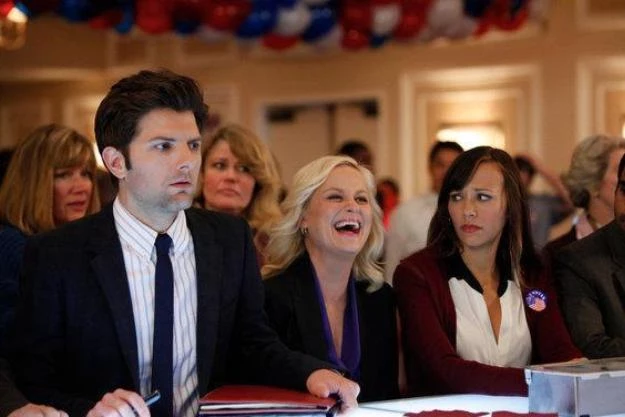
Yaaaaaaay!
 This, on the other hand, might well be a perfect show. Leslie Knope, April Ludgate, Ron F---ing Swanson... Just typing the names gives me a big goofy grin. Every episode is a half-hour ray of blissful sunshine, brightening my spirits with a healthy dose of feminism, Amy Poehler, and laughter. Roll on Thursday (by then I might even have stopped crying about the breakup of the century).

How I Met Your Mother (9/24)

I still watch this show, I guess. I can't really remember why.

Bob's Burgers (9/30)

The charming adventures of the most delightful animated family since The Simpsons deserve a full-length treatment at some point. For now I simply say: Watch it. If the hijinks of close-knit siblings Tina, Gene, and Louise don't fill you with joy, you have a shriveled husk in place of a soul. Also, Kristen Schaal! Eugene Mirman! H. Jon Benjamin, for crying out loud! (HEY, FX, WHEN IS ARCHER COMING BACK ALREADY?)

Tina's my favorite. No, Gene is. No, it's Louise. Oh, don't make me choose!
 The Good Wife (9/30)

For a sitcom-loving sci-fi nerd like myself, a legal drama is well outside the comfort zone, but this is about as good as they come. The juxtaposition of title and premise alone should grab any feminist's attention: When her husband is embroiled in an Eliot Spitzer-style scandal, Alicia Florrick returns to the bar in order to make ends meet. The rich ironies and tensions suggested by the show's title play out on Julianna Margulies' understated yet beautifully expressive face as she navigates personal and professional life when she has so long been defined as Peter Florrick's wife. And sometimes Michael J. Fox guest stars, and it's awesome.

30 Rock (10/4)

For several seasons now, 30 Rock has been but a pale shadow of its best self, but laughs are still guaranteed, and my love for Liz Lemon is fierce and undying. I will almost certainly complain vociferously about every episode, but I wouldn't dream of missing out on bidding farewell to the TGS crew.

It's Always Sunny in Philadelphia (10/11)

In some ways, this is the anti-Parks and Rec: A crass and often vicious show about crass, wholly unlikeable people. You won't see anyone hailing the Sunny gang as feminist icons anytime soon (though, for what it's worth, the jokes are usually on the holders of prejudice rather than the victims thereof). I'd like to revisit the episodes featuring Carmen, a trans woman, to see how they stack up against the generally appalling mainstream pop-culture depiction of trans women, but I'm honestly a little afraid to do so. When Sunny misses, it misses hard, but it's also capable of making me laugh until I cry; and, unlike a certain other 2005-premiering show mentioned above, I'm actually optimistic about the chance for creativity and entertainment in Sunny's eighth season.

Community (10/19)

The date is on my calendar and on my heart. Friday, October 19th, 8:30pm: The stars will align. The cosmos will come into harmony. Wars will end. Justice will prevail. God will be in his heaven and all will be right with the world.

ASDFSDALF;HDSLGJKHSJDK

Friday, September 23, 2011

Fall TV: 2011 Edition

So I'm a grad student now (preen, ponce, smug, big words). What I didn't know going in was that, unlike high school, undergrad, and being un- or underemployed, grad school involves rather a lot of hard graft. This means that my TV-watching time is drastically diminished. This fall I will only have time to follow The Daily Show, The Colbert Report, How I Met Your Mother, Raising Hope, Glee, Modern Family, Community, Parks & Recreation, It's Always Sunny in Philadelphia, Archer, The Good Wife, Boardwalk Empire, and the last few episodes of Breaking Bad. Between reading approximately 487251 pages of academic articles per week, writing assignments, working in the campus kitchens, church, soccer, jam circle, game night, hiking group, and weekly karaoke, I just can't squeeze in any new shows.

Luckily, none of the new shows is worth the time it takes to type the title. I know this because my now legendary talent for judging the value of a new show has gotten so sensitive that I don't even need to see the pilot before evaluating it with pinpoint accuracy. Accordingly, I have not watched a single pilot this fall. (Well, except Up All Night, which seduced me with the wonderful Maya Rudolph. This time last year, Will Arnett would also have been a major draw, but I have not yet recovered from Running Wilde *shudder*).

So here it is: your handy, spectacularly ill-informed, print-out-and-keep guide to the Fall 2011 TV Season!

2 Broke Girls
Plot:
Straight white people are boring
Letter Grade: Zzz

Pan Am
Plot:
Straight white people are boring
Letter Grade: Zzz

The Playboy Club
Plot:
Straight white people are boring
Letter Grade: Zzz

Ringer
Plot:
Straight white people are boring
Letter Grade: Zzz

I Hate My Teenage Daughter
Plot:
Straight white people are boring
Letter Grade: Zzz

Revenge
Plot:
Straight white people are boring
Letter Grade: Zzz

Suburgatory
Plot:
Straight white people are boring
Letter Grade: Zzz

Up All Night
Plot:
Straight white people are boring
Letter Grade: Zzz

Person of Interest
Plot:
Straight white people are boring
Letter Grade: Zzz

The Secret Circle
Plot:
Straight white people are boring
Letter Grade: Zzz

Whitney
Plot:
Straight white people are boring
Letter Grade: Zzz

New Girl
Plot:
Straight white people are boring
Letter Grade: Zzz

A Gifted Man
Plot:
Straight white people are boring
Letter Grade: Zzz

Last Man Standing / Man Up / How To Be A Gentleman
Plot:
Are you fucking kidding me?

Wednesday, June 22, 2011

Game of Thrones Season One

My most-viewed blog post, by quite a large margin, is Drinking Game of Thrones. (I enjoy the thought of hordes of unengaged people idly googling “game of thrones drinking game”, finding my post, and then getting slammed by the stealth anti-racism.)

That was eight weeks ago, though, and now the first season of Game of Thrones has come to a close. I suppose this means I should have five times as many thoughts as I did back then. Here are some of them.

As a whole, I liked the show. It has its problematic elements, natch. For one thing, I could honestly go the rest of my life without encountering another male-dominated story. It's gotten to the point where, if I pick up a book thinking it looks interesting but see that the protagonist is male, I put it down again. Only a really cool premise, a recommendation from someone I trust, or an author I love can make me read a book about a man. And yet (as we shall see) just because Game of Thrones is set in a male-dominated world doesn't mean it's necessarily a male-dominated story (see also: Boardwalk Empire).

For another thing, GRATUITOUS NUDITY. HBO has a fixation with this. The trouble is that US network TV is so puritanical, HBO goes too far in the opposite direction just because it can – like a teenager from a strict home who's away at university for the first time and goes a little wild. Maybe if the rest of US TV would just grow up a little, HBO wouldn't feel the need to shower its programming with BOOBIES. It's as if somebody said, “All these characters are a little confusing. Every other episode we need a scene where some man monologues for ten minutes about things the audience would already know if they'd been paying attention. But how to make this unnecessary exposition palatable? Ah yes, BOOBIES!” Honestly, it baffles me. We live in the internet age. Every viewer can see all the boobies they could possibly want at the click of a mouse. Why do we need gratuitous porn in our TV shows?

And, of course, lest they be accused of unequal-opportunity pornifying, the producers slung in a couple of dick shots as well. Wow. You know, I hate cats and have never seen an episode of The L Word, and if that ever makes me feel like Not A Real Lesbian, all it takes is one TV schlong to assure me that I couldn't be gayer if I threw out all my skirts and changed my name to Shane. Seriously, my straight and bi sisters? You're... you're really into that?

“But Anna,” you are yelling, “enough with the nekkidness already. You've written 400+ words, and you haven't even mentioned racism!”

Well, quit yelling; it's annoying your housemates. As you know, I have serious problems with the crass Orientalism of the Dothraki storyline, but I think it takes great strides toward redemption with that devastating scene between Dany and Mirri Maz Duur (here be spoilers, if I need to say it). Dany can't believe the woman she so nobly rescued would betray her; Mirri Maz Duur icily describes everything that happened to her before Dany's oh-so-noble white-woman intervention: “Look to your khal and see what life is worth, when all the rest is gone.” Unlike in the book, this scene is separated from the one where Dany suffocates Drogo. As such, it has the space to emphasize Mirri Maz Duur and to speak unarticulated volumes about the relationship between conqueror and conquered.

That was arguably my favorite moment in the season; but, gratuitous nudity notwithstanding, there were plenty of other things I liked too. For all my whining about male-dominated stories, I think the show did some pretty great things with its female characters. Both Catelyn and Cersei were much more engaging to me in the show than in the book. In Catelyn's case, it might have been the fact that I didn't have to listen to her inner monologue carp about Jon Snow, which was all she ever seemed to bloody do in the book; but both women, thanks to excellent performances from Michelle Fairley and Lena Headey, had real depth to their characters that allowed them to exist as much more than just mothers and wives.

Even Sansa had a moment in the final episode that made me think she's not quite as unutterably tedious as she'd been up to that point. In her case, witnessing her thought processes gave me a good deal more sympathy for her in the book than in the show; without them, her progression from vapid teenager to shrewd and desperate survivor isn't as clear. I have high hopes for her in the second season, though.

And need I even mention Arya, and the 52 varieties of ass she kicks?

What I like most, though, is that what Game of Thrones is really about is “cripples, bastards, and broken things”. All the most compelling and sympathetic characters are the ones who are disadvantaged in the dog-eat-dog world of Westeros: women, PWD, a dwarf, a eunuch, an illegitimate son. The powerful non-disabled male characters, who think they hold the reins, are either flat-out evil or fatally myopic, and it's the people they continue to underestimate – Arya, Cersei, Tyrion, Varys – who will make them pay.

I think there's an interesting contrast here with The Walking Dead. Oh, how I hated The Walking Dead. (When its second season starts in October, I plan to finish a long-overdue blog post about how much and why I hated it. Sneak preview: one of the reasons is racism!) It's not an entirely fair comparison, because my familiarity with the source material gives GoT an advantage in my affections, but for two high-budget, highly-anticipated, highly-acclaimed TV shows, I've had very different reactions. And I think it's because TWD sidelines its cripples, bastards, and broken things, while GoT actually, despite what “starring Sean Bean” might lead you to believe, foregrounds them.

Wednesday, April 27, 2011

Drinking Game of Thrones

I bought a copy of A Game of Thrones two or three years ago. It spent those years languishing pristine, untouched, and accusatory on the shelf between my well-thumbed copies of Temeraire and The Name of the Wind, intimidating me by its 700 pages and its Tolkien comparisons. At the end of March, the imminence of the TV adaptation's première compelled me to finally pick it up. I raced through it in ten days and enjoyed the H-E-double-hockey-sticks (as my beloved TV wife Rachel would say) out of it.

We're two episodes into the TV show now, so it's high time I passed judgment. My ability to accurately assess a TV show after two episodes is incontrovertibly documented in my Very Secret Diaries, which you may not read, but here are some excerpts:

28th September 2010 – on episode 2 of Lone Star: “I really liked it, but the ratings for it are so godawful that it probably hasn't a prayer of finishing out the season.”

2nd October 2009 – on episode 2 of Flash Forward: “Flash Forward treats me like an eejit and I swear if it continues to be this bad I will drop it soon.” [One episode later, I did.]

25th September 2009 – on episode 2 of Community: “[A]bsolutely terrific – a perfect balance of snarky humor and genuine character-based pathos. If it keeps going like that it has the potential to be a cult and critical favorite.”

See? I'm the new Alan Sepinwall. QED.

I've been watching Game of Thrones (the article appears to have been dropped) with my brother, who hasn't read the book. I can help him keep track of who the many characters are and compare the show to the book; he can offer me an evaluation of the show qua television. In places, though, it's an uncomfortable watch for a brother and sister, so we have developed a system for coping with all the squickiness. We call it “Drinking Game of Thrones”:

Incest? DRINK.

Titties? DRINK.

Buttcrack? DRINK.

Unfortunate Implications? DRINK.

Prince Joffrey (because he is such a little shit, I just hate him that much, that I have to drink whenever he is onscreen)? DRINK.

Something rapey happens? DRINK.

The thing is, most of the rapeyness and the Unfortunate Implications are taken straight from the book*. The show just highlights all of the aspects of the book that made me uncomfortable.

*Apart from that scene with Daenerys and her maidservant. That was entirely gratuitous and exploitative lesbian subtext, and I say this as a lesbian-subtext connoisseur and enthusiast.

I should point out that A Game of Thrones isn't half as sexist as a lot of fantasy books. It's still rapey enough for us to have nicknamed it, with a nod to Patton Oswalt, Rape Throne: The Throne That Rapes People, but women are present and they do have a voice. The first book cycles through eight characters' points of view, half of them female; and, while it's set in a medieval-style world that oppresses women, the female characters' personalities range from the controlling, Livia-like Cersei to the weak, submissive Sansa to the defiant, gender-non-conforming Arya. Arya is my favorite character in both the book and the show: she's only a little girl, but she's still a bona-fide BA (and not in the sense that I am).

The whole storyline with Daenerys, however, is rife with extremely uncomfortable implications in both iterations. Some of that is clearly intentional – the unbelievably creepy brother molesting his sister and selling her to be another man's wife – but the rest of it... well. In the book (minor spoiler, y'all), Dany comes to love her new husband devotedly. It smacks of Stockholm Syndrome to me, and I'm genuinely not sure if Martin intended that.

For example, take the consummation of Dany and Drogo's marriage. Bookside, Dany (who is just thirteen; I think – hope – they aged her up for the show) is completely terrified, and Drogo engages in a lot of foreplay to prepare her for penetrative sex. For some time, Dany finds the nightly sex painful, but gradually she comes to enjoy it.

In the show, though, Drogo just straight-up rapes her. I mean, not that I would characterize the book version as consensual as such, but he does at least wait until she tells him “yes”. Which is rapier: penetrating your new bride as she weeps and tries to cover herself up, or stroking and caressing her as she weeps until she's so aroused she invites you to penetrate her?

You see why I find it deeply problematic, right?

I think, for the most part, this is intended to be problematic. Obviously, not having read the sequels yet, I don't know how Daenerys' story will play out, but it's not implausible that she's deliberately written as a woman dealt a really crappy hand in life who does what she needs to do in order to cope psychologically. What's less explainable is the racial implications of this storyline.

As my brother said: “Racist undertones in a fantasy book?? Surely not!” Point taken, but I still think this deserves analysis.

It always bothers me when people excuse rampant rape and the erasure of POC in fantasy by saying, “It's authentic, 'cause it's based on medieval England/northern Europe!” Sure, but seasons didn't last for years on end and dragons didn't exist in medieval England, and I don't hear anyone complaining that dragons and years-long winters make it inauthentic. It's FANTASY. Shakesville articulated it best: “It says something interesting, and not at all pleasant, about our culture that we are willing to accept a complete reinvention of the planet's climate for the purposes of fantasy, but not the possibility of a culture devoid of sexual exploitation and rape”. Sub out “sexual exploitation and rape” for “white supremacy” and you have another, equally legitimate complaint.

Virginal, whiter-than-white maiden Daenerys is taken by a tribe of brown-skinned savages who live wild, shag like animals, rape her, and make her their queen (the only black character I've seen so far is her maidservant). It's fantasy, yes, but even a fantasy novel exists in the real world and is not divorced from real-world history: a history in which white people's colonialism oppressed and exploited people of color “for their own good”, in the name of civilizing the savages; in which predominantly white countries still invade predominantly brown countries “for their own good” whilst ignoring human rights abuses in resource-poor, predominantly black sub-Saharan Africa; in which the Jim Crow narrative of sexually animalistic black men preying on lily-white women was constructed by white men in order to perpetuate their control over both black men and white women. (Black women? Don't be silly, they don't exist.) These racist cultural narratives still persist. They persist in the international policy decisions of western countries; they persist in the difference in mainstream media coverage of stories about white people and stories about people of color; and they persist in fantasy novels and TV shows that recreate them.

I believe fiction has a duty, if not to show us a better world, then at least to be aware of when it's showing us terrible things. Game of Thrones is not aware of its own racism. As far as I'm concerned, this means I have to mention it every time I talk about it. I can talk about the successful character interactions, and the plot points that feel a bit awkward and rushed, and the sweeping moments that rouse fantasy-epic stirrings of excitement deep in my gut, and how God handcrafted every inch of Peter Dinklage out of the finest Olympic win – but I'm also going to talk about the racism.